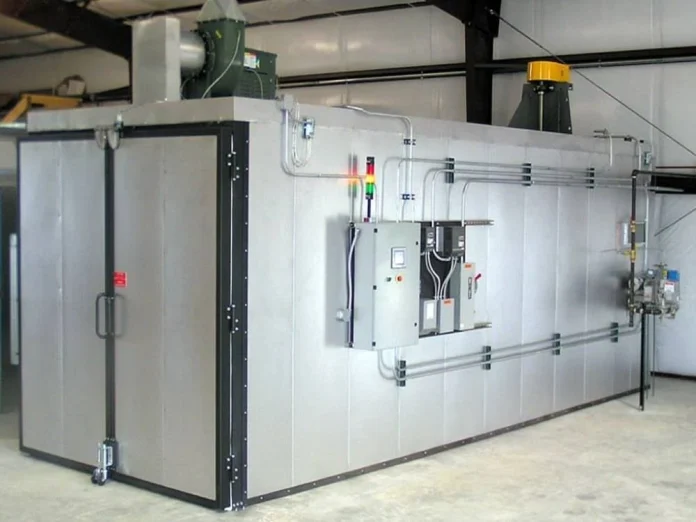

Metal thickness changes the way a powder coating oven has to work. Thin sheet metal heats quickly, while heavy plate, castings, and welded assemblies need more time for heat to reach the center of the part. Reliable curing depends on matching oven capacity, airflow, rack loading, and cycle time to the actual metal moving through production.
Metal Thickness Changes How Quickly Parts Reach Cure Temperature
Thin components can approach oven temperature relatively fast because there is less metal mass to heat. Sheet-metal panels, brackets, cabinets, and light fabricated pieces may therefore require shorter warm-up periods before the coating reaches its specified cure conditions.
Heavier steel behaves differently because additional mass absorbs more heat before the entire part reaches temperature. Reliant powder coating ovens can be sized around this thermal load so production schedules account for the time needed to heat thick assemblies rather than relying only on the oven’s air-temperature reading.
Why Does Part Temperature Matter More Than the Oven Setpoint?
Controller readings show the air temperature inside the chamber, but they do not prove that the workpiece itself has reached the required cure temperature. Thick sections can lag well behind surrounding air, especially during the early portion of a heating cycle.
Temperature profiling gives operators a clearer picture by tracking the metal during actual production loads. A Reliant industrial powder coating oven can support large or heavy work, but cure timing still needs to reflect part mass, powder specifications, rack density, and the point at which the substrate reaches the required temperature.
Airflow Helps Heat Reach Uneven Shapes More Consistently
Circulating air distributes heat around racks, corners, cavities, and surfaces that may otherwise warm at different rates. Good airflow becomes particularly important with mixed geometries, where broad panels and thick welded joints can respond very differently inside the same load.
Mixed Loads Need More Careful Rack Planning
Combining thick and thin parts in one oven load can make production convenient, but the two materials may not heat at the same pace. Lightweight pieces could reach cure temperature well before heavier components, which means the cycle usually has to accommodate the slowest-heating item.
Rack spacing also influences how freely heated air moves around each component. Shops using a Reliant powder coating equipment package can plan booth loading and oven racks together so densely packed work does not create cold areas or unnecessarily extend each cure cycle.
How Can Shops Avoid Overheating Thin Metal Parts?
Thin parts respond quickly to changing oven conditions, so unnecessary exposure can waste production time and may affect certain powder finishes. Operators can reduce this risk by following the coating manufacturer’s cure window and confirming actual metal temperature rather than adding extra time as a general safety margin.
Consistent loading improves repeatability because similar rack weights and part arrangements produce more predictable heating patterns. Reliant powder curing ovens can become easier to schedule when production teams group compatible components and document successful cure profiles for recurring jobs.
Booth Throughput Should Match the Oven’s Heating Capacity
Fast application does not increase finished output if coated racks spend too long waiting for oven space. A powder coating booth may handle thin parts rapidly, while heavier products can occupy the curing chamber for extended periods and create a queue between spraying and heating.
Balanced Reliant powder coating systems account for that difference during equipment sizing. Facilities comparing a Reliant powder coating oven for sale should estimate the number of racks completed per shift, average metal thickness, heating time, and load frequency instead of selecting an oven simply because every part fits inside.
Heavy Weldments Put More Demand on Oven Recovery
Large frames, machinery components, structural assemblies, and thick plate can pull substantial heat from the oven as soon as a cool load enters. Heating capacity must recover from that temperature drop while continuing to circulate enough hot air around the work. Repeated heavy loads place even greater demand on burners, insulation, fans, and temperature controls. Reliant powder coating equipment intended for this type of production should be evaluated around loaded operating conditions, since an empty oven can reach temperature far more easily than one filled with dense steel.
The Right Oven Setup Depends on the Parts Produced Every Day
Actual production history provides better sizing information than a single maximum part dimension. Manufacturers should review metal thickness, component weight, rack density, powder chemistry, batch frequency, available floor space, and expected daily output before deciding what oven configuration fits the operation.
Reliant Finishing Systems offers Reliant powder coating equipment and oven options for manufacturers curing everything from lightweight fabricated parts to substantial steel assemblies. Their equipment can be matched with booth capacity, part dimensions, thermal load, and production goals, helping shops build a curing process that handles thin and thick metal without treating very different parts as though they heat at the same rate.