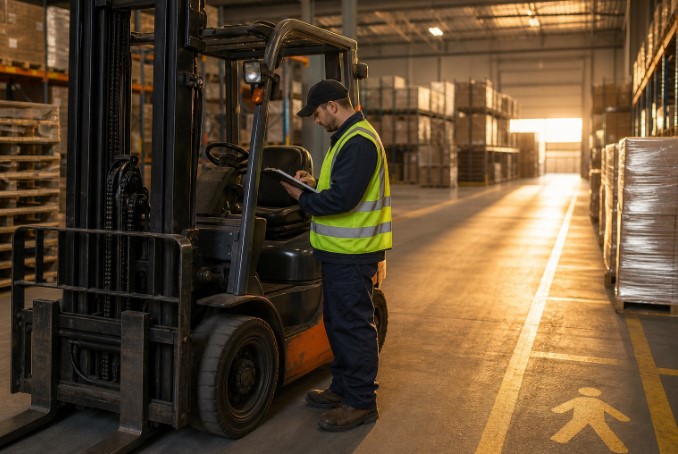

Key Takeaways
- Safe forklift operations rely on capable operators, dependable equipment, and organized work areas.
- Pre-use inspections help identify defects before equipment is placed into service.
- Marked pedestrian paths and controlled vehicle routes reduce opportunities for traffic conflicts.
- Load stability, travel speed, visibility, and floor conditions must be considered on every trip.
- Near misses and maintenance records can reveal hazards before a serious incident occurs.
Forklifts are essential in warehouses, distribution centers, loading docks, and manufacturing facilities, but they also create serious hazards when people, products, and vehicles share limited space. A strong safety program makes safe choices routine rather than leaving them to chance. For example, a planned forklift certification renewal process can help supervisors confirm that operators remain prepared for the equipment and conditions at their facility.
Forklift safety is not only the operator’s responsibility. Pedestrians, order pickers, supervisors, maintenance personnel, truck drivers, and visitors all affect the safety of a shared work environment. Clear expectations, visible routes, clean aisles, and prompt corrections give everyone a better chance to recognize hazards before someone is hurt.
Why Forklift Safety Deserves Daily Attention
Warehouse conditions change quickly. Pallets move, staging areas fill, trailers arrive, spills occur, and temporary workers may enter unfamiliar areas. A blocked aisle, a blind corner, poor lighting, or a damaged pallet can turn an ordinary task into a high-risk situation. OSHA identifies powered industrial trucks, material handling, slips and trips, and pedestrian contact as hazards that warehouse operations must control.
Facilities should treat forklift safety as part of daily operations, not as a response after an incident. OSHA’s warehouse safety guidance also notes that its updated National Emphasis Program for Warehousing and Distribution Center Operations began inspections on July 31, 2026, making this a practical time to review site controls, records, and work practices.
Build a Strong Operator Training Program
Effective training combines instruction, hands-on practice, and an evaluation of the operator’s ability to use the specific truck safely. Training should fit the workplace. A reach truck in narrow aisles, a counterbalanced forklift at a dock, and a pallet jack in a retail stockroom present different operating demands.
Match Training to Actual Conditions
- Teach operators how facility traffic patterns, ramps, dock plates, racks, and floor surfaces affect handling.
- Review the types, weights, and shapes of loads handled at the site.
- Provide refresher training when unsafe behavior, an incident, a near miss, or a major workplace change shows that it is needed.
- Allow new operators to practice in a controlled, low-traffic area before assigning them to a busy shift.
A qualified evaluator should observe how an operator travels, turns, loads, unloads, parks, and interacts with pedestrians. Safe operation involves judgment, not simply the ability to move a forklift from one point to another.
Use a Daily Forklift Inspection Checklist
Operators should examine a forklift before operating it to identify conditions that could make it unsafe. A simple inspection record, whether paper or digital, should identify the date, operator, equipment number, findings, and corrective action taken. In multi-shift facilities, procedures should make it clear when each truck is checked and who reports defects.
- Test brakes, steering, horn, lights, alarms, and seat belt, when equipped.
- Inspect forks, mast, chains, guards, load backrest, and hydraulic lines for visible damage or leaks.
- Check tires, wheels, battery connections, fuel components, and fluid levels as appropriate for the truck.
- Verify that controls operate correctly and that no warning indicator requires attention.
Any forklift with a safety-related defect should be removed from service and clearly identified until authorized repairs are completed. Operator inspections do not replace scheduled maintenance, but they can prevent damaged equipment from being used between service intervals.
Design Safer Forklift and Pedestrian Routes
Mixed traffic is especially dangerous at doors, aisle intersections, docks, staging areas, and rack ends. Mark pedestrian walkways where people regularly travel, define forklift lanes where the layout permits, and keep both routes free of stored material. Guardrails, bollards, gates, mirrors, warning lights, and audible alerts can provide additional protection at high-risk locations.
Consider a blind intersection near a receiving dock. A convex mirror may improve awareness, but it should not be the only safeguard. A one-way travel pattern, a marked pedestrian crossing set away from the corner, lower speed expectations, and a requirement to sound the horn can work together to reduce conflict.
Control Speed, Visibility, and Distractions
There is no single safe speed for every warehouse. Operators should adjust travel to the load, available sightlines, pedestrian activity, floor condition, turning space, and stopping distance. Clean aisles, working lights, and maintained mirrors make it easier to identify people and obstacles early enough to stop safely.
Operators should look in the direction of travel and maintain a clear view of the route. When a load blocks forward visibility, the operator should travel in the direction that provides the safest view, while following site procedures and accounting for ramps, turns, and nearby workers. Phones, headphones, horseplay, sudden turns, and travel with elevated forks all introduce avoidable risk.
Handle Loads With Care
Before lifting, operators should verify the truck’s rated capacity and assess the load’s condition. Damaged pallets, loose wrapping, uneven weight distribution, and oversized materials can shift during transport. Center loads on the forks, keep them low while moving, and use only the mast tilt needed to support stability.
Never use a forklift to carry passengers unless it is designed and equipped for that purpose. Keep workers away from raised forks and elevated loads, and use added caution on ramps, wet floors, uneven surfaces, dock plates, and trailer transitions. OSHA’s forklift hazard guidance also emphasizes stable, balanced loads and adequate clearance during lifting and travel.
Keep Aisles, Docks, and Storage Areas Clear
Clutter reduces visibility and leaves less room for safe stopping and turning. Loose shrink wrap, broken pallets, tools, spills, and misplaced inventory should be removed promptly. Storage practices should protect travel lanes, emergency exits, fire equipment, electrical panels, and access to loading areas.
A short start-of-shift floor walk can identify blocked routes, damaged racking, poor housekeeping, or dock hazards before work becomes busy. Supervisors should also confirm that trailer restraints, dock equipment, and staging practices support the work being performed.
Maintain Equipment and Learn From Events
Scheduled maintenance should follow the manufacturer’s instructions and address recurring issues such as tire wear, brake problems, hydraulic leaks, battery problems, and damaged forks. Repeated defects may indicate rough floors, overloading, inadequate servicing, or unsafe operating practices, so maintenance records should be reviewed during regular safety meetings.
Near misses should lead to learning rather than blame. Make the area safe, provide medical assistance when needed, document what occurred, identify contributing factors, correct the hazard, and share the lesson with the team. Trends in reports can guide changes to training, layout, equipment maintenance, and supervision.
Simple Steps to Start This Week
- Walk forklift routes and identify blocked, confusing, or low-visibility areas.
- Review the inspection form with every operator.
- Confirm pedestrian lanes are visible and unobstructed.
- Tag and remove unsafe forklifts from service.
- Review operator training and evaluation records.
- Discuss one recent near miss at the next safety meeting.
- Schedule a full warehouse safety review.
Conclusion
Reliable forklift safety comes from consistent actions: trained operators, careful inspections, stable loads, controlled traffic, clear work areas, and prompt repairs. When leaders and workers address small hazards every day, they create a warehouse that is safer, more orderly, and better prepared for the demands of modern material handling.