
Key Takeaways
- Automation supports consistent placement, timing, and inspection across repeat production runs.
- Automated optical inspection can identify many visible assembly defects, but it cannot prove every board functions correctly.
- Traceability connects each board to materials, machine settings, inspection results, and repair history.
- Skilled technicians remain essential for exception handling, first-article review, and process improvement.
- Strong quality control begins before assembly and continues through final testing and documentation.
Orange County, California product teams often need to move quickly from prototype to production while keeping reliability front and center. Choosing custom circuit board assembly Orange County CA can give local businesses a practical way to coordinate engineering questions, production changes, and quality expectations without treating assembly as a separate final step.
Automation is changing that conversation. Modern PCB assembly equipment can apply solder paste, place components, guide boards through reflow, and inspect visible conditions with repeatable settings. For Orange County companies developing industrial controls, connected devices, lab equipment, or specialized electronics, the goal is not simply faster output. It is a more controlled process that makes it easier to prevent, detect, and investigate defects.
Why Quality Control Is Changing
Boards continue to fit more functionality into smaller spaces, with tightly spaced components, fine-pitch connections, and packages whose solder joints may not be visible after assembly. At the same time, buyers expect dependable lead times. Waiting until the end of production to discover a defect pattern can lead to rework, material waste, and shipment delays. Quality control is therefore more effective when it is built into each production stage.
Where Automation Fits In
Automated PCB assembly uses programmed equipment to complete repeatable tasks such as solder paste printing, component placement, reflow soldering, and inspection. A properly controlled placement program, for example, can place the same approved component at the same coordinates and orientation across a production run. That repeatability is especially valuable when a design moves from a small local build to recurring orders.
Automation does not remove the need for planning. It works best when component data, footprints, bills of materials, and assembly instructions are accurate before production begins. Small and midsize manufacturers looking to improve workflows can also draw on the manufacturing assistance available through NIST’s MEP network, which supports operational improvement and risk reduction across U.S. manufacturing.
The Role Of Automated Inspection
Automated optical inspection, often called AOI, uses cameras and programmed criteria to compare assembled boards against expected conditions. It can flag missing parts, incorrect polarity, component offset, lifted leads, solder bridges, visible solder shortages, and other observable issues. The scope of automated optical inspection in PCB manufacturing helps explain why it is commonly positioned at multiple points along an assembly line.
AOI results depend on the program, lighting, component library, board finish, and acceptance thresholds. A flag is not always a confirmed defect. Conversely, a board that passes visual inspection may still contain an electrical or hidden-joint issue. Three-dimensional solder paste inspection can help evaluate paste deposits before placement, while X-ray inspection can provide visibility into certain concealed connections.
Why Inspection Is Not Enough
Each test method answers a different question. A balanced quality plan may include:
- AOI: Reviews visible component placement and solder conditions.
- X-ray inspection: Examines hidden solder joints and internal package structures.
- In-circuit testing: Checks selected electrical connections, component values, and circuit conditions.
- Functional testing: Verifies that the finished board performs its intended task.
- Manual review: Resolves unusual calls, complex defects, and conditions outside automated rules.
The right mix depends on product risk, board density, production volume, test access, and the consequences of field failure. No single method can detect every possible problem.
Traceability And Production Records
Traceability means being able to follow a specific board through its major production events. Useful records may include the board revision and serial number, component lot or reel details, solder paste handling information, machine programs, process settings, inspection images or results, rework records, and final test outcomes.
For Orange County teams managing rapid engineering changes, these records can make root cause analysis more direct. They help distinguish whether a failure is associated with a design revision, a material lot, an assembly setting, or an isolated repair decision. Traceability also helps identify which units may be affected when a problem is found after shipment.
The Value Of Human Oversight
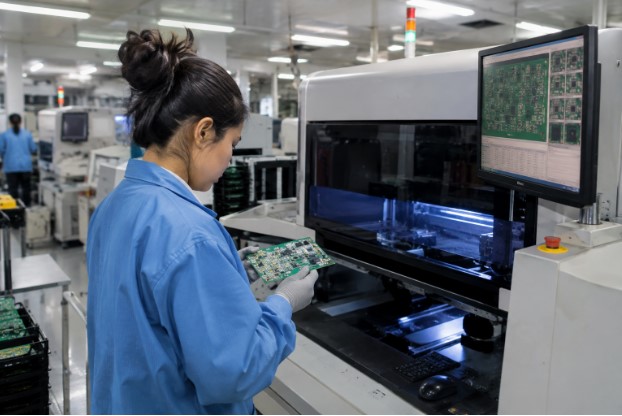
Automated systems are highly useful at repetitive comparisons, but they can produce false calls and may not recognize every unusual condition. Trained technicians validate flagged conditions, review borderline solder joints, and assess whether a finding is meaningful for the product’s intended use.
Human oversight matters most during first-article builds, new-component introductions, process changes, and design revisions. The strongest approach combines machine consistency with people who can maintain inspection rules, review recurring defects, and adjust the process based on evidence.
A Practical Quality Workflow
- Review the design for footprints, polarity markings, component spacing, test points, and assembly notes.
- Confirm that the bill of materials, placement data, drawings, and approved revision match.
- Verify incoming materials, packaging, moisture controls, and authorized substitutions.
- Inspect solder paste printing and verify placement orientation and accuracy.
- Monitor reflow conditions, then run appropriate automated inspection.
- Perform in-circuit or functional testing when the product requires it.
- Document defects, rework, approvals, and final disposition.
- Review defect trends and correct recurring causes before the next build.
Common Mistakes To Avoid
- Using final inspection as the only quality gate.
- Producing boards from outdated or mismatched files.
- Assuming AOI can detect hidden-joint or electrical failures.
- Overlooking substitutions, lot changes, or undocumented rework.
- Setting inspection thresholds so tightly that false calls overwhelm review capacity, or so loosely that real issues pass through.
- Skipping first-article review after a design or process change.
What To Watch Through 2026
Quality systems increasingly connect inspection data, machine information, material records, and test results. Machine vision and artificial intelligence may help teams classify recurring inspection calls or speed the creation of inspection programs, but results still need validation against real boards and known defects. Useful technology should improve a measurable outcome, such as faster investigation, fewer repeat defects, or clearer production records.
Frequently Asked Questions
Can Automated Inspection Replace Manual Inspection?
No. Automation can reduce repetitive visual review, but trained people are still needed for setup, exceptions, process changes, and difficult defect decisions.
What Is The Difference Between AOI And Functional Testing?
AOI evaluates visible assembly conditions. Functional testing evaluates whether the completed board performs as intended.
When Is X-Ray Inspection Useful?
X-ray is useful for inspecting solder joints or structures that are concealed from standard cameras, including certain bottom-terminated and area-array packages.
Why Does Traceability Matter?
It provides teams with evidence to investigate failures, identify affected units, and separate design, material, and process issues.
Conclusion
Automated PCB assembly is not merely a collection of machines. In Orange County, California, reliable production comes from connecting sound design practices, controlled assembly steps, appropriate inspection, electrical testing, traceable records, and skilled human judgment. Automation improves consistency, while disciplined review and continuous improvement protect the quality that customers ultimately experience.